Study Sites
The EMERGENTS ICEMR is situated at the intersection of West and Central Africa, focused on two countries with differential malaria transmission intensities and disease risk. Nigeria is considered holoendemic for malaria; however,endemicity is heterogeneous across the various ecological zones of the country, complicating malaria control efforts. Whereas in Cameroon, malaria transmission is heterogeneous across the country, ranging from perennial transmission in the southern forested regions to seasonal and unstable transmission in the northern Soudano-savannah as well as Sahelian regions.
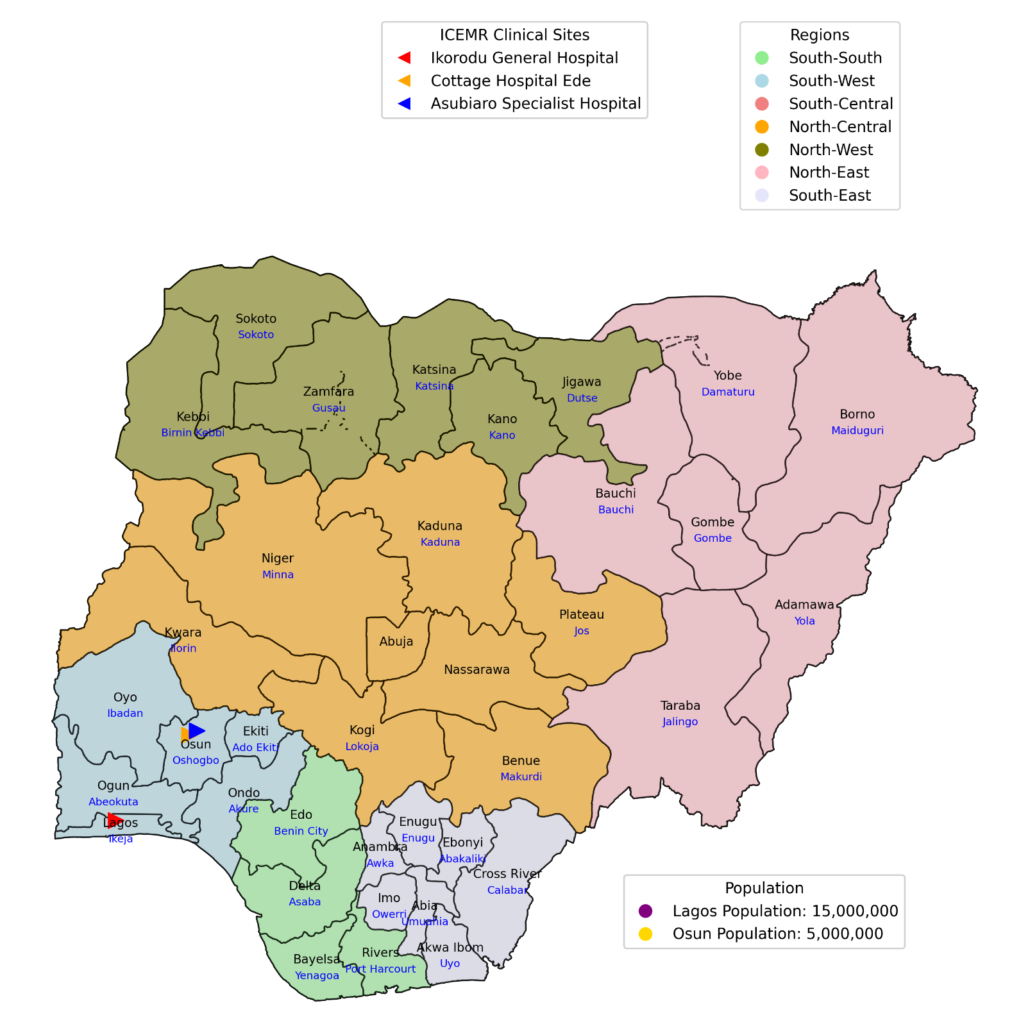
In Nigeria, activities of the EMERGENTS ICEMR focuses on 3 main sites, Cottage, Asubiaro, and Ikorodu. In Cameroon, activities of EMERGENTS ICEMR focuses in Douala and Yaoundé, the two most important cities in the country and where malaria transmission is holoendemic and perennial. The project will also be implemented at the community level in Olama, a rural area located 50km from Yaoundé in the Centre region. Here secondary vectors such as An. moucheti are more abundant than the main malaria vectors (An. gambiae sl and An. funestus).

Advancing malaria research, surveillance, and control through the implementation of applied genomics and translational systems biology approaches in an exigent malaria nexus of West and Central Africa.
Lead Institutions: University of Florida (USA), Institute of Genomics and Global Health (Nigeria), and the Centre for Research in Infectious Diseases (Cameroon)
In Cameroon, activities of EMERGENTS ICEMR focuses in Douala and Yaoundé, the two most important cities in the country and where malaria transmission is holoendemic and perennial. Douala, along the coast, is in the forest ecological zone of Cameroon, where malaria transmission is holoendemic and perennial. This ecological zone has diverse interspersed ecosystems, i.e., a humid savannah, with a humid climate and heavy rainfall (between 1500 and 5000 mm3 each year) during the rainy season. Yaoundé is the political capital of Cameroon. It is located 250 km inland, east of Douala, and is the second largest city with a population close to 2.5 million. Yaoundé is laid out concentrically with the center containing most administrative and commercial facilities. It is surrounded by a patchwork of native districts that maintain strong social and cultural identities. The climate is sub‐equatorial Guinean (mean annual rainfall and temperature of 1600 mm and 25°C, respectively). There are two distinct rainy seasons, one extending from March to June and another from September to November
The project will also be implemented at the community level in Olama, a rural area located 65km from Yaoundé in the Centre region. This location displays high and perennial malaria transmission patterns. It is located within the Congo-Guinean phytogeographic zone, characterized by a typical equatorial climate with two rainy seasons extending from March to June and September to November. Mean annual rainfall ranges between 1600–1800 mm. Here, secondary vectors such as An. moucheti are more abundant that main malaria vectors (An. gambiae sl and An. funestus).
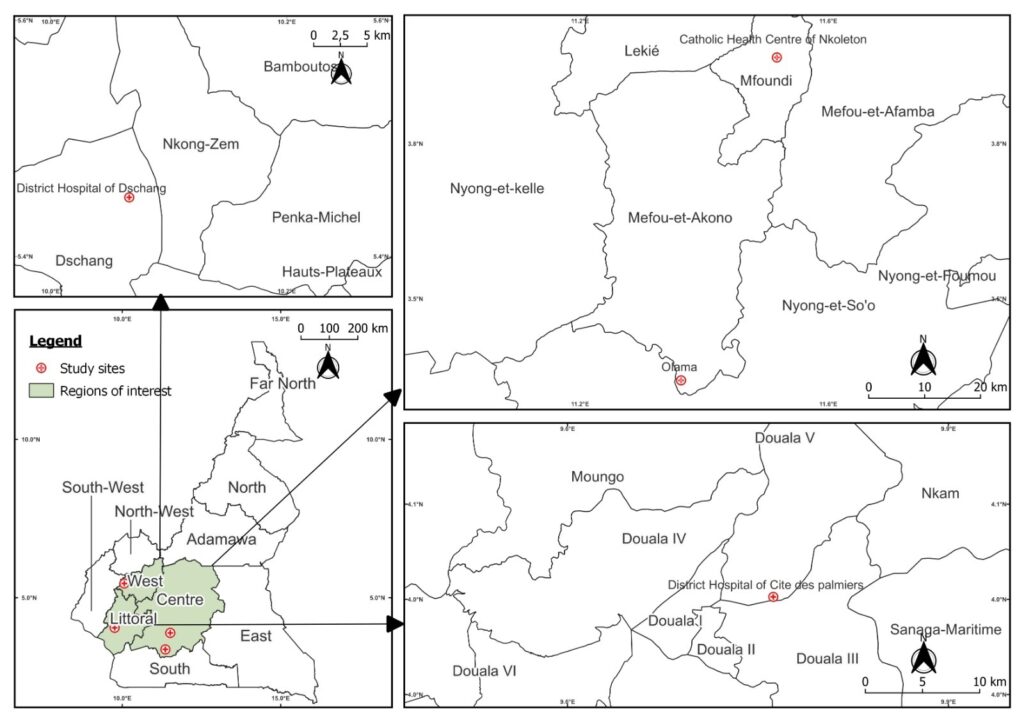
View Associated Sites for the Emergents ICEMR in Nigeria and Cameroon in a larger map